
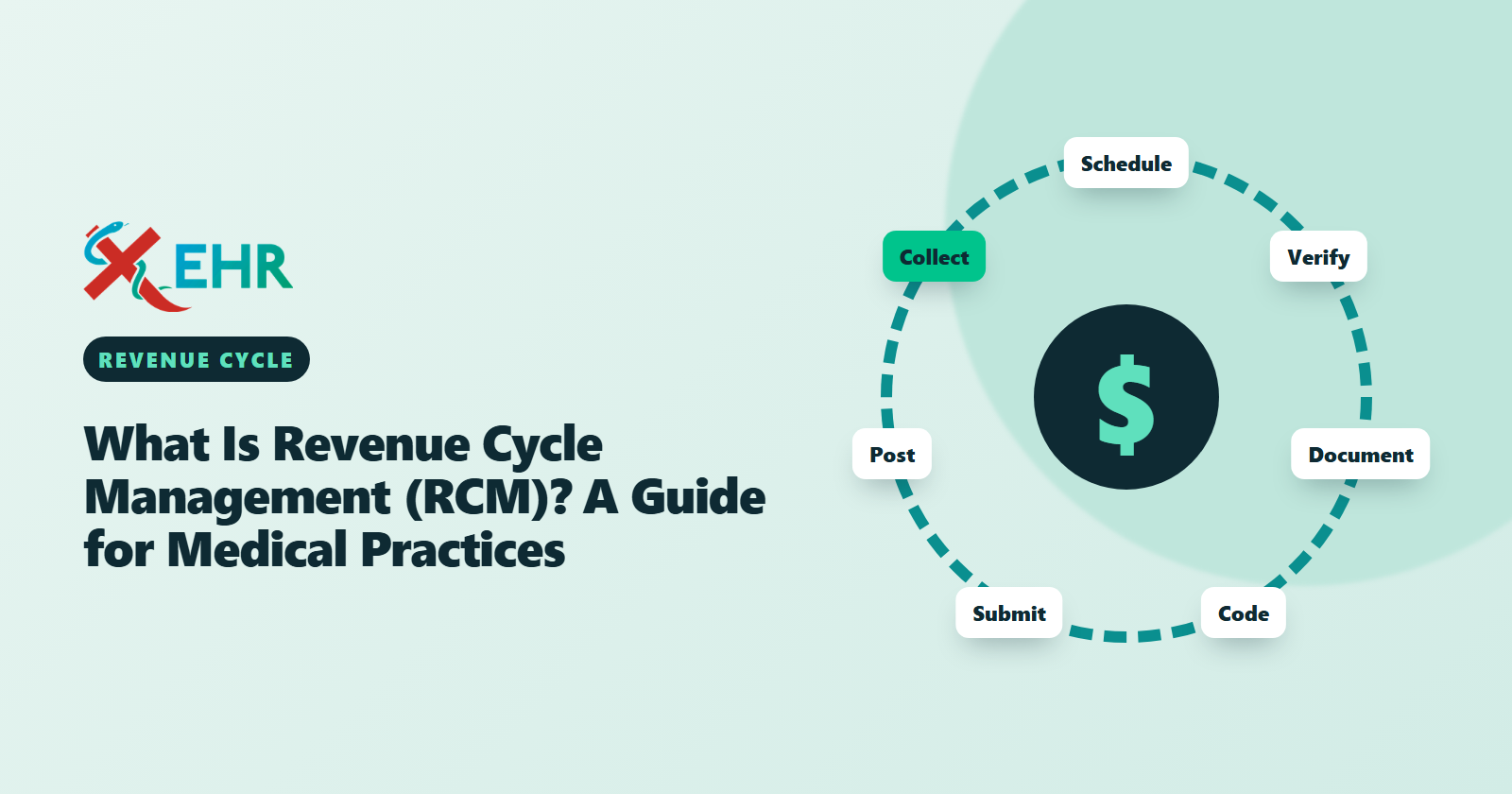
- RCM is every step from scheduling to the final payment, not just claims.
- Most revenue problems start at the front end: registration, eligibility and authorization.
- Four metrics tell you most of what you need: clean claim rate, denial rate, days in A/R and net collection rate.
- Whether you run billing in-house or outsource it, the software underneath decides how much work is manual.
Every practice earns revenue when it delivers care, but only collects it at the end of a chain of steps. Revenue cycle management is the discipline of running that chain well, so that the money you earn becomes money you are paid, quickly and in full.
The stages of the revenue cycle
Front end: before and at the visit
- Scheduling and registration: accurate demographics and insurance captured once.
- Eligibility and benefits: coverage, copay and deductible confirmed before the visit.
- Prior authorization: approvals obtained for services that need them.
Middle: the visit itself
- Documentation: the note supports what was done and why.
- Coding and charge capture: diagnoses and services coded from the signed note, with no charges missed.
Back end: getting paid
- Claim submission: claims scrubbed and sent electronically.
- Payment posting: remittances (ERA) posted, adjustments applied, underpayments spotted.
- Denial management: denials worked and appealed within deadlines.
- Patient balances: clear statements and easy ways to pay.
The metrics that matter
| Metric | Definition | Why it matters |
|---|---|---|
| Clean claim rate | Claims accepted with no edits or rejections ÷ claims submitted | Shows the quality of claims leaving your office |
| Initial denial rate | Claims denied on first submission ÷ claims submitted | Shows how well the front end works |
| Days in A/R | Total accounts receivable ÷ average daily charges | How fast work turns into cash |
| Net collection rate | Payments ÷ (charges minus contractual adjustments) | How much of what you are owed you actually collect |
Where practices lose money
- Bad registration data, which produces rejections and eligibility denials.
- Missed authorizations, which produce denials for care already delivered.
- Charges never billed because a note was unsigned or a service never reached the claim.
- Denials nobody worked before the appeal deadline.
- Patient balances that are never billed clearly or followed up.
Close the loop between the back end and the front end
The most effective revenue teams treat every denial as information about an earlier step. A denial for inactive coverage is a registration problem; a denial for a missing authorization is a scheduling and ordering problem; a denial for a missing modifier is a coding problem. When the billing team sends a short monthly summary of denial reasons back to the front desk and the providers, the same mistakes stop repeating, and the denial rate falls without anyone working harder.
A monthly revenue cycle review
Set aside an hour a month with whoever owns billing and walk through the same short list:
- Accounts receivable by age. How much is outstanding in each bucket (0–30, 31–60, 61–90 and over 90 days), and is the oldest bucket growing?
- Denials by reason and by payer. Which three reasons cost the most this month, and which payer is behind them?
- Unbilled visits. Visits with no claim yet, usually because a note is unsigned or a charge is missing.
- Underpayments. Claims paid below the contracted rate that should be appealed.
- Patient balances. How much patients owe, how old it is, and whether statements went out.
- One fix for next month. Pick the single change that would remove the biggest leak, and assign it to a person.
The patient side of the revenue cycle
Patients now pay a meaningful share of many visits through deductibles and coinsurance, so the patient experience is part of the revenue cycle. Practices collect more when patients are told their expected share before the visit, receive one clear statement instead of several confusing ones, can pay online or by text, and can set up a payment plan without a phone call. Collecting the known copay at check-in is still the simplest improvement most practices can make.
Questions to ask an RCM service
If you are considering outsourcing, compare vendors on the same questions:
- How are you paid? A percentage of collections aligns the vendor with your revenue; per-claim pricing can reward volume over results.
- What exactly is included? Eligibility, authorizations, coding review, appeals, patient statements and credentialing are often priced separately.
- Which system do you work in? Billing inside your own EHR keeps notes, claims and payments in one record; a separate billing system means data moving between the two.
- What reports will we see, and how often? Ask for the four metrics above, monthly, by payer and by provider.
- Who owns the data and how do we leave? Contract length, notice period and how your records come back to you if you switch.
In-house, outsourced, or both
In-house billing
- Full control and visibility
- Needs trained staff and good software
- Best when volume justifies a team
RCM as a service
- Experts run billing for you
- Fewer staff to hire and manage
- Best when billing is not your core strength
What to look for in RCM software
- Eligibility checks before every visit.
- Prior authorization tracked from ordering to claim.
- Claims built from the signed note, with no re-typing.
- Scrubbing before submission, with clear fixes.
- Automatic ERA posting and a denial work queue with reasons.
- Reports on the four metrics above, by payer and by provider.