
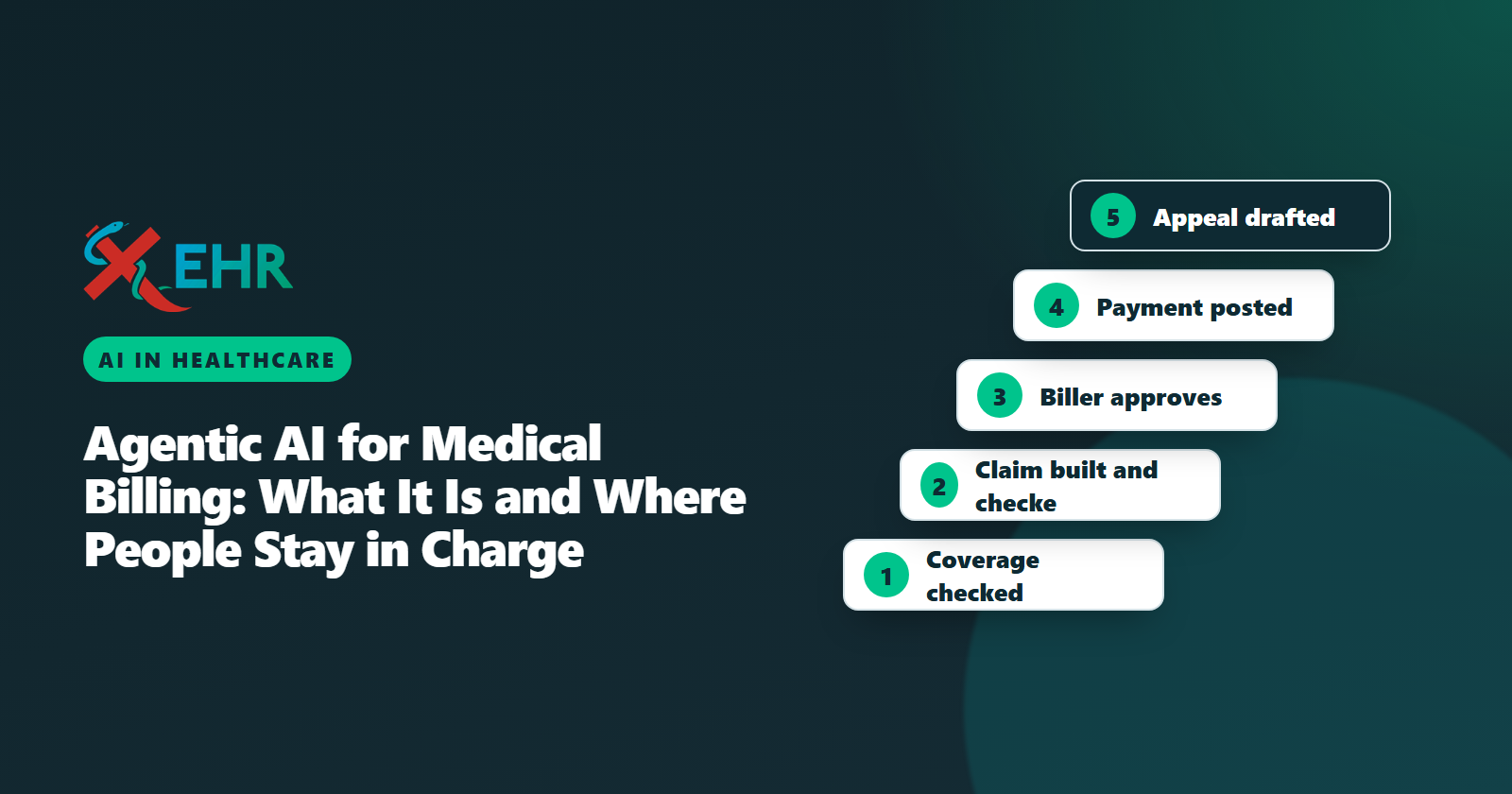
- Agentic AI completes billing work end to end - checks, preparation, follow-up - instead of waiting for someone to click each step.
- It differs from RPA, which breaks when anything changes, and from copilots, which only answer when asked.
- The work is large: practices report about 13 hours a week on prior authorization alone, and reworking one denied claim costs about $118.
- The right line: agents run the repetitive steps; people sign notes and approve every claim and appeal.
Medical billing is a chain of small, rule-heavy tasks: check coverage, build the claim, check it, send it, follow it, post the payment, work the denial. Most of that chain is repetitive. Agentic AI is the first kind of software that can carry the chain forward on its own, step by step, and stop where a person should decide.
What “agentic” means in billing
Most billing software is a set of screens. People do the work; the software stores it. An AI copilot adds a helper that answers questions or suggests text when someone asks. An AI agent is different: it is given a goal - “get this visit paid correctly” - and it takes the steps toward it, reading the chart, the coverage and the payer’s responses as it goes.
| Rules-based automation (RPA) | AI copilot | Agentic AI | |
|---|---|---|---|
| What it does | Repeats fixed clicks | Answers or suggests when asked | Completes the task toward a goal |
| When a rule or screen changes | Breaks and waits | Waits for a question | Reads the change and adapts |
| Exceptions | Pile up for staff | Explained if asked | Worked, with the next step prepared |
| Who approves | Nobody, until it fails | The user, every time | People approve what matters |
Why billing needs it now
The administrative load keeps growing. In the AMA’s physician surveys, practices report spending about 13 hours a week on prior authorization alone. Denials are expensive to work: a national denials index found that about 9% of hospital claims were initially denied, and estimated the cost of reworking a single denied claim at about $118. And payer rules keep moving - under the CMS Interoperability and Prior Authorization Final Rule, impacted payers must decide standard prior authorization requests within 7 calendar days from 2026 and offer electronic prior authorization APIs from 2027.
None of that work needs a person for every click. Much of it needs a person for the final decision.
What AI agents do across the revenue cycle
- Eligibility and benefits. The agent checks coverage before each visit and flags what changed, so the front desk confirms with the patient instead of discovering it on a denial.
- Claim preparation and checks. The claim is built from the signed visit and checked before it is sent: required fields, diagnoses that support each service, correct coding pairs and unit limits.
- Prior authorization. Services that commonly need approval are flagged when ordered, and the request is prepared from the chart for staff to review and submit.
- Status and follow-up. Every open claim is tracked, and the ones that need a call or are close to the payer’s filing limit surface first.
- Payment posting. Insurance payments are matched to their claims and posted, and only the exceptions go to a person.
- Denials and appeals. The agent reads the payer’s reason, suggests the fix and drafts the appeal with the right documentation attached.
Where people must stay in charge
Autonomy should stop where accountability starts. A useful rule: agents can do anything that is a check, a lookup or a draft; people make anything that is a commitment.
Agents run on their own
- Eligibility and benefits checks
- Claim checks before sending
- Claim status tracking
- Payment posting
- First drafts of notes, appeals and requests
People always decide
- Signing every clinical note
- Submitting every claim
- Sending every appeal
- Submitting prior authorizations
- Overriding a check, with a reason
This line matters for compliance as much as for safety. A claim is a statement to a payer about care that was provided, so the practice should always be able to say who reviewed and sent it.
How to evaluate agentic AI for your practice
Ask any vendor these questions before you buy:
- What exactly does the agent do on its own, and what does it hand to a person? Ask to see the line drawn, step by step.
- Does it work inside the record? Agents that live inside the EHR see the whole chart, coverage and claim history; bolt-on tools see only what they are given.
- Can every action be traced? You should be able to see what an agent checked, what it drafted and who approved it.
- What happens when it is unsure? Good agents stop and ask; they do not guess on money.
- Is there a Business Associate Agreement? Any AI that touches patient data must be covered by a BAA.
How to start
Most practices get value fastest by starting with the steps that are pure checks: eligibility before every visit and a claim check before every submission. Then add payment posting, then denial drafting. Measure your first-pass acceptance rate and days in A/R before and after, so the gain is visible.
See also our guides to reducing claim denials and prior authorization automation, and the agentic AI overview.