
- Original Medicare has five appeal levels; most practice appeals are won at the first two.
- The first deadline is 120 days for redetermination; reconsideration follows within 180 days.
- Not every denial needs an appeal: clerical errors are often fixed faster as a reopening or corrected claim.
- Strong appeals answer the specific denial reason with documentation, not a general letter.
A Medicare denial is not the end of the claim. Original Medicare (Parts A and B) gives providers a structured, five-level appeals process. Knowing which level you are at, what the deadline is and what evidence to send is the difference between recovering the payment and writing it off.
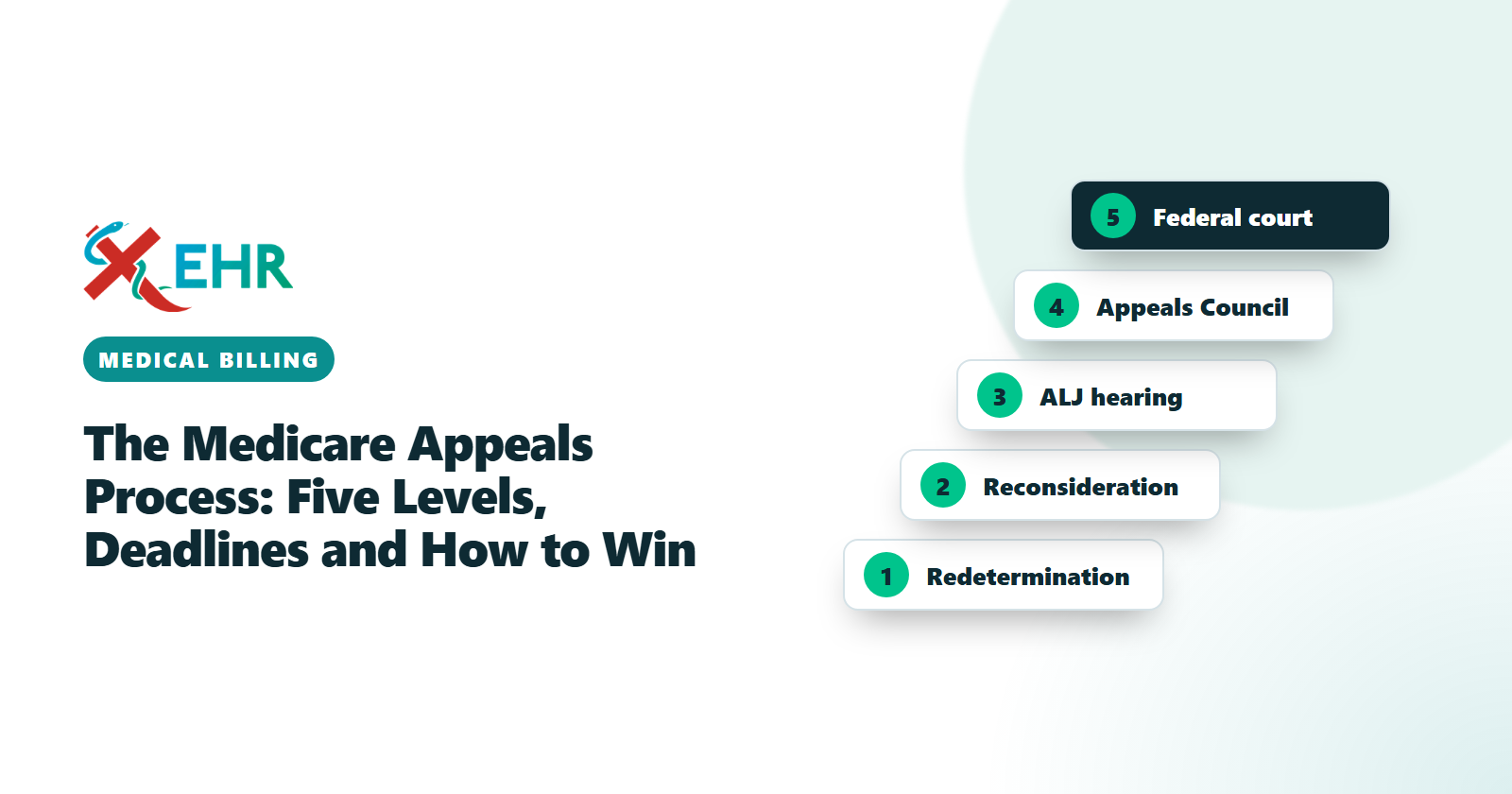
The five levels at a glance
| Level | Who decides | Deadline to file |
|---|---|---|
| 1. Redetermination | Medicare Administrative Contractor (MAC) | 120 days from receipt of the initial determination |
| 2. Reconsideration | Qualified Independent Contractor (QIC) | 180 days from receipt of the redetermination |
| 3. Hearing | Administrative Law Judge (ALJ) | Generally 60 days; minimum amount in controversy applies |
| 4. Council review | Medicare Appeals Council | Generally 60 days |
| 5. Judicial review | Federal district court | Generally 60 days; minimum amount in controversy applies |
Each level must be completed for a claim before moving to the next.
First, decide: appeal or correct?
Many “denials” are really errors that are faster to fix than to appeal.
Correct or reopen
- Wrong or missing modifier
- Incorrect patient or provider data
- Wrong date of service or units
- Clerical mistakes you can fix
Appeal
- Medical necessity disputed
- Coverage or frequency decision you disagree with
- Documentation supports the service as billed
Level 1: Redetermination
The MAC that processed the claim reviews it again, by staff who were not involved in the original decision. File within 120 days of receiving the remittance advice. There is no minimum dollar amount.
What to send: the redetermination request form or a letter with the required information, the claim and denial details, and documentation that answers the denial reason directly: the signed note, orders, test results, prior authorization, an Advance Beneficiary Notice if one was signed.
Level 2: Reconsideration
If the redetermination is unfavorable, a Qualified Independent Contractor reviews the case. File within 180 days of receiving the redetermination decision. This is usually your last good chance to add evidence: documentation not submitted by this level may not be accepted later without good cause.
Levels 3 to 5
An Administrative Law Judge hearing, Medicare Appeals Council review and federal court review each generally allow 60 days to file and, for the ALJ and court levels, require a minimum amount in controversy that CMS updates each year. Practices reach these levels rarely; high-value or repeated denials may justify it.
How to build an appeal that wins
- Answer the reason code, not the claim. Read the denial reason and remark and address exactly that.
- Send the evidence that proves it: the signed note showing medical necessity, orders, results, authorizations.
- Keep it organized: a short cover letter, the claim, the denial and labeled documents.
- Track every deadline in a work queue, counted from the date of receipt.
- Learn from it. If the same denial repeats, fix the documentation, template or check that caused it.
A redetermination letter that reviewers can follow
Reviewers read many requests a day. Make yours easy to decide:
- Identify the claim at the top: patient name and Medicare number, date of service, claim number, the service and the amount in dispute.
- State what you are asking for in one sentence: “We request redetermination of the denial of the office visit on this date of service.”
- Quote the denial reason exactly as it appears on the remittance, then answer it point by point.
- Point to the evidence. Do not just attach the chart; name the page and the line that proves the point (“the progress note documents the failed earlier treatment”).
- List the enclosures with labels that match the documents.
- Sign and date it, and keep a copy with proof of when it was sent.
The Advance Beneficiary Notice: prevention, not appeal
Some denials cannot be won because Medicare does not cover the service in that situation. When you expect Medicare may deny a service as not reasonable and necessary, give the patient an Advance Beneficiary Notice of Noncoverage (ABN) before the service. A properly completed ABN lets the patient decide with full information and allows the practice to bill the patient if Medicare denies. Without one, the practice usually cannot collect from the patient for that denial. Keep signed ABNs in the record and mark the claim accordingly.
Track appeals like any other work
Appeals are lost most often because a deadline passed, not because the case was weak. Keep every open appeal visible with:
- the claim and patient,
- the appeal level and the date the decision letter was received,
- the filing deadline, counted from receipt,
- who owns it and what evidence is still missing,
- the outcome and amount recovered.
A monthly look at outcomes by denial reason shows which appeals are worth the effort and which denials should be prevented at the source instead.
Commercial and Medicare Advantage plans
Commercial and Medicare Advantage plans have their own appeal levels and deadlines, set in your contract and the plan’s provider manual, and often shorter than Original Medicare’s. Keep each payer’s appeal window visible in your work queue.
General information based on CMS and Medicare contractor guidance; confirm current deadlines and thresholds with your MAC.
RelatedThe XEHR platform